
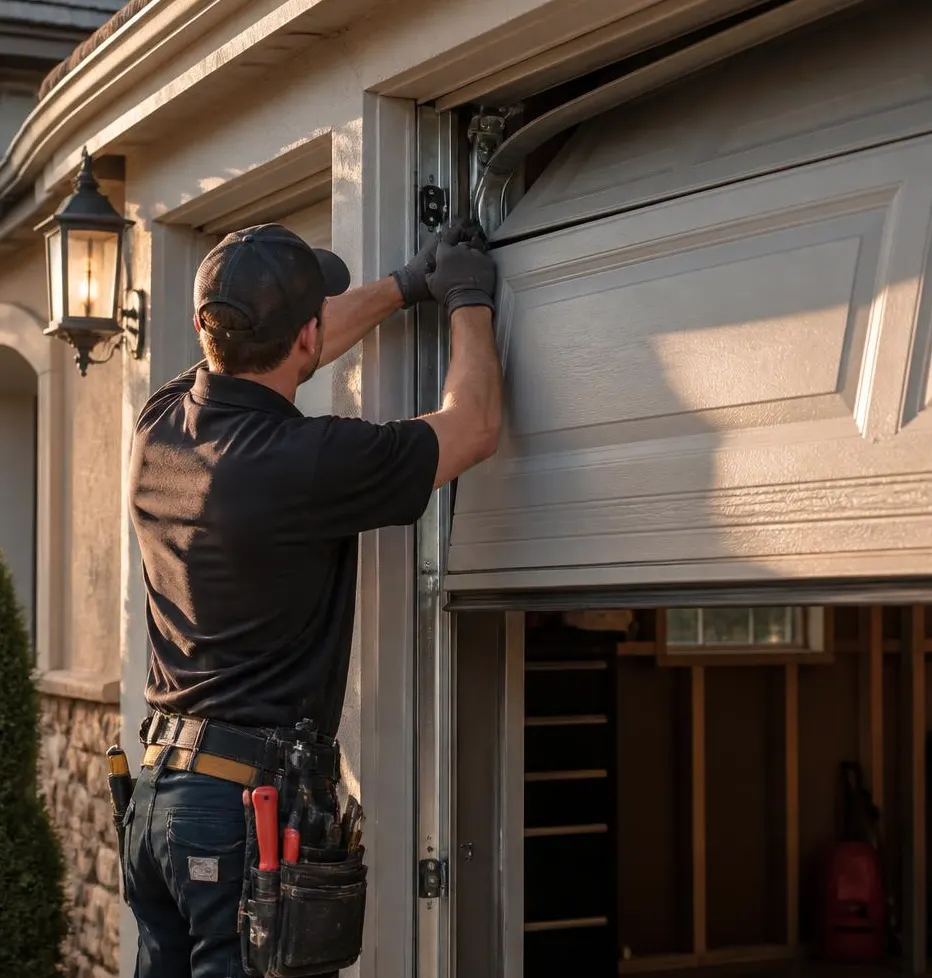
The Mistake Almost Everyone Makes First
The door won't budge, so you mash the opener button again. And again. When that doesn't work, you grab a shovel or pry bar and try to break the seal free at the bottom. It's tempting because it feels like the fastest fix — the door is right there, frozen in place, and a little force seems like it should do the trick.
The problem is that both habits make things worse. Repeatedly hitting the opener while the door is stuck forces the motor to fight against resistance it was never built to overcome, which can strip the drive gear or burn out the motor. Prying at the bottom panel can bend the frame, crack the weatherstripping, or pop the door off its track entirely. Before you touch the opener or grab a tool, it helps to know what's actually going on.
What You're Likely Seeing
- The door won't move at all, and the bottom edge looks iced to the concrete.
- The opener motor runs but the door doesn't go anywhere, or it clicks without lifting.
- The door moves, but slowly and unevenly, groaning or jerking at certain points.
- The door reverses itself partway up or down, even with nothing blocking it.
- One side lifts before the other, so the door travels crooked in the track.
Each of these points to a different cause, and they're not all equally urgent. Here's the order a technician would actually check them in.
1. Ice Bonding the Door to the Floor
This is the first thing to rule out, and it's the most common cause after a hard freeze, ice storm, or a day where slush dripped off the car and refroze overnight. Water collects along the bottom seal, freezes, and glues the rubber to the concrete. The opener isn't broken — it just can't win a fight against ice.
The fix: Don't pour hot water on it; that just adds more moisture that refreezes within minutes in a Detroit winter. Instead, use a plastic scraper or the edge of a putty knife to gently break the ice seal along the full width of the door before trying to open it. A bag of ice melt or sand along the base afterward helps prevent it from rebonding overnight.
2. Hardened Grease on Rollers and Hinges
Next, a technician checks the rollers. Standard lubricant thickens in deep cold, and old grease that's picked up dust and road salt over the years gets even stiffer. The rollers don't spin freely in the track — they drag, which is what causes that slow, jerky motion even after the ice is gone.
The fix: Clean old grease and grit off the rollers, hinges, and track with a rag, then apply a silicone-based lubricant rated for cold temperatures. Avoid WD-40 as a long-term lubricant here — it's a solvent that displaces moisture short-term but doesn't hold up well once temperatures swing again.
3. Spring Tension Lost to the Cold
If the door moves manually (with the opener disconnected) but feels heavier than usual, or the opener strains and stalls partway through the cycle, the torsion or extension springs are next on the list. Metal contracts in cold weather, and springs that were already near the end of their lifespan can lose enough tension that they no longer counterbalance the door's weight properly.
The fix: This is not a DIY repair. Torsion springs are under enough tension to cause serious injury if handled without the right tools and training. A technician measures the door's weight against spring tension and replaces or adjusts the springs to restore proper balance.
4. Track Alignment Shifted by Cold or Frost Heave
If only one side of the door lifts unevenly, or it binds at the same spot every time, the tracks themselves may have shifted slightly. Older garages — common throughout Detroit, Redford Township, and Dearborn — often sit on slabs that move a little with frost and thaw cycles, and that can nudge track brackets out of alignment over a season or two.
The fix: A technician checks the tracks with a level, re-tightens or repositions the mounting brackets, and confirms the door travels straight on both sides. This is also when any bent track sections from winter impacts get caught.
5. The Opener Itself
Last on the list, because it's the least likely cause but still worth ruling out: the opener's gears, limit settings, or force settings. If the motor runs but the chain or belt doesn't engage, or the door reverses without an obstruction, cold weather can be exposing a gear that was already close to failing, or force settings that need recalibrating now that the door's resistance has changed.
The fix: Inspection of the drive gear, limit switches, and force settings, with repair or replacement of worn components.
When to Call Detroit Garage Door
If you've cleared the ice and the door still won't move smoothly, or it feels noticeably heavier than it did last month, that's usually the springs — and that's a call for our Spring Repair & Replacement service rather than something to troubleshoot further yourself. If the door is stuck shut entirely and you need it moving today, our Emergency Garage Door Service covers that, whether it's late at night or during a weekend freeze.
We work throughout Detroit, Southfield, Royal Oak, Ferndale, Dearborn, Redford Township, Oak Park, and Berkley, and we see this same pattern every winter — ice, hardened grease, and tired springs, usually in that order. Call Detroit Garage Door today to get your door moving smoothly again before the next deep freeze sets in.